Why Competence Is No Longer Enough

In most organizations, “good” leadership is the quiet gold standard. These leaders hit their numbers, show up prepared, and run meetings that don’t generate complaints. They are solid, dependable, and competent.
But according to new research, there is a hidden liability hiding in plain sight: In times of uncertainty, “good” leadership doesn’t produce good outcomes. It produces anxiety, complacency, and the slow erosion of trust.
We are operating in an era of economic volatility, AI disruption, and constant restructuring. The ground is shifting. And the leadership gap that should concern you isn’t the distance between poor and good. It’s the distance between good and exceptional.
The 54% Problem
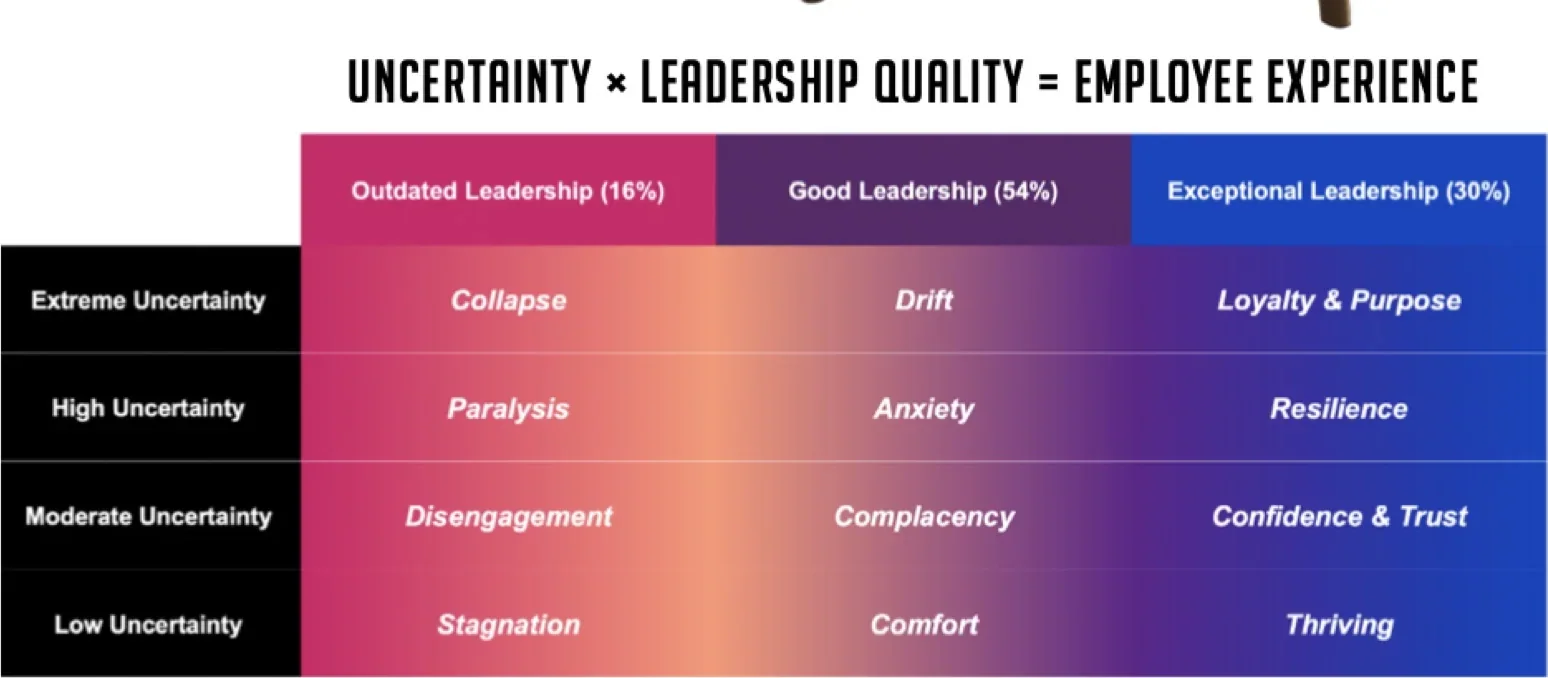
In partnership with The Harris Poll, a survey of 2,206 employed Americans revealed a stark breakdown of leadership effectiveness:
54% of leaders fall into the “good” category—producing suboptimal results during uncertainty.
30% are rated as “exceptional.”
16% are “outdated,” still relying on a command-and-control playbook.
That means nearly three out of four leaders are falling short of what their people actually need right now.
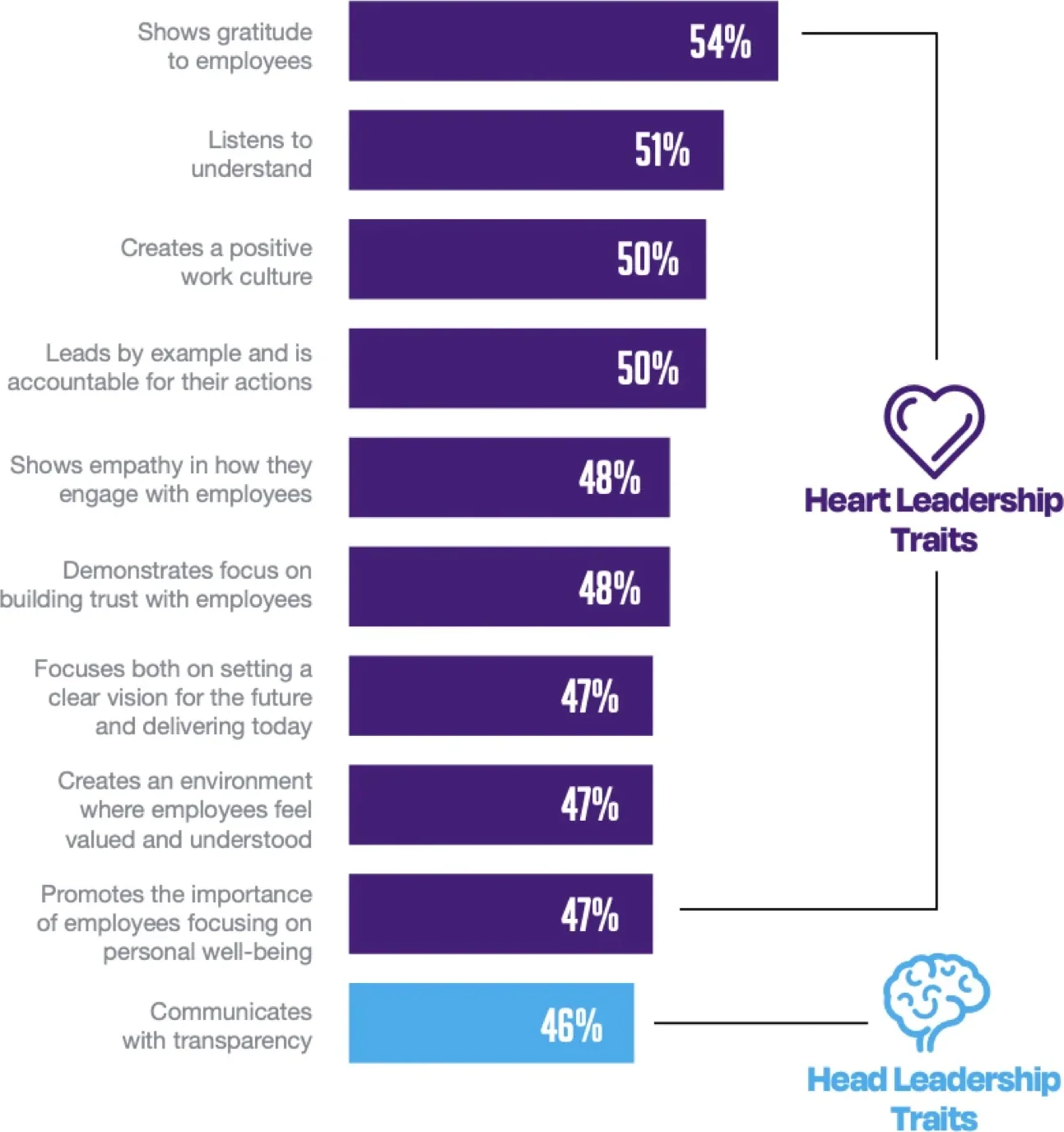
Perhaps most striking is where the performance gap lies. When researchers analyzed the top ten attributes that separate exceptional leaders from good ones, nine of them were “Heart” attributes—gratitude, listening, empathy, and trust. Only one (communicates with transparency) fell on the “Head” side.
The gap isn’t about strategy, operations, or technical skill. You likely already have those. What’s missing are specific communication behaviors.
What Employees Actually Feel
Under “good” leaders, employees feel supported and appreciated. The basics are covered. But they do not feel heard. They do not feel that what matters to them is valued. They do not feel they are thriving or reaching their potential.
Only 16% of employees under good leaders feel what is important to them is valued (vs. 26% under exceptional).
Only 19% feel heard (vs. 26%).
Only 14% feel they are reaching their full potential (vs. 22%).
Good leaders aren’t failing catastrophically. That is what makes this so hard to see. But in uncertain times, that emotional gap becomes the difference between resilience and drift.
The Leadership Formula: Uncertainty × Quality = Experience
The research introduces a simple but powerful framework: Uncertainty × Leadership Quality = Employee Experience.
When high uncertainty meets good leadership, the outcome isn’t paralysis—it’s anxiety, complacency, and drift. These are the silent killers of transformation. They don’t announce themselves like a crisis. They accumulate gradually, in meetings where people nod but don’t commit.
When high uncertainty meets exceptional leadership, the outcome flips entirely: resilience, confidence, trust, loyalty, and purpose.
Same environment. Same pressures. Completely different experience. The difference isn’t the storm. It’s who is steering the ship.
The Six Behaviors That Separate Good from Exceptional
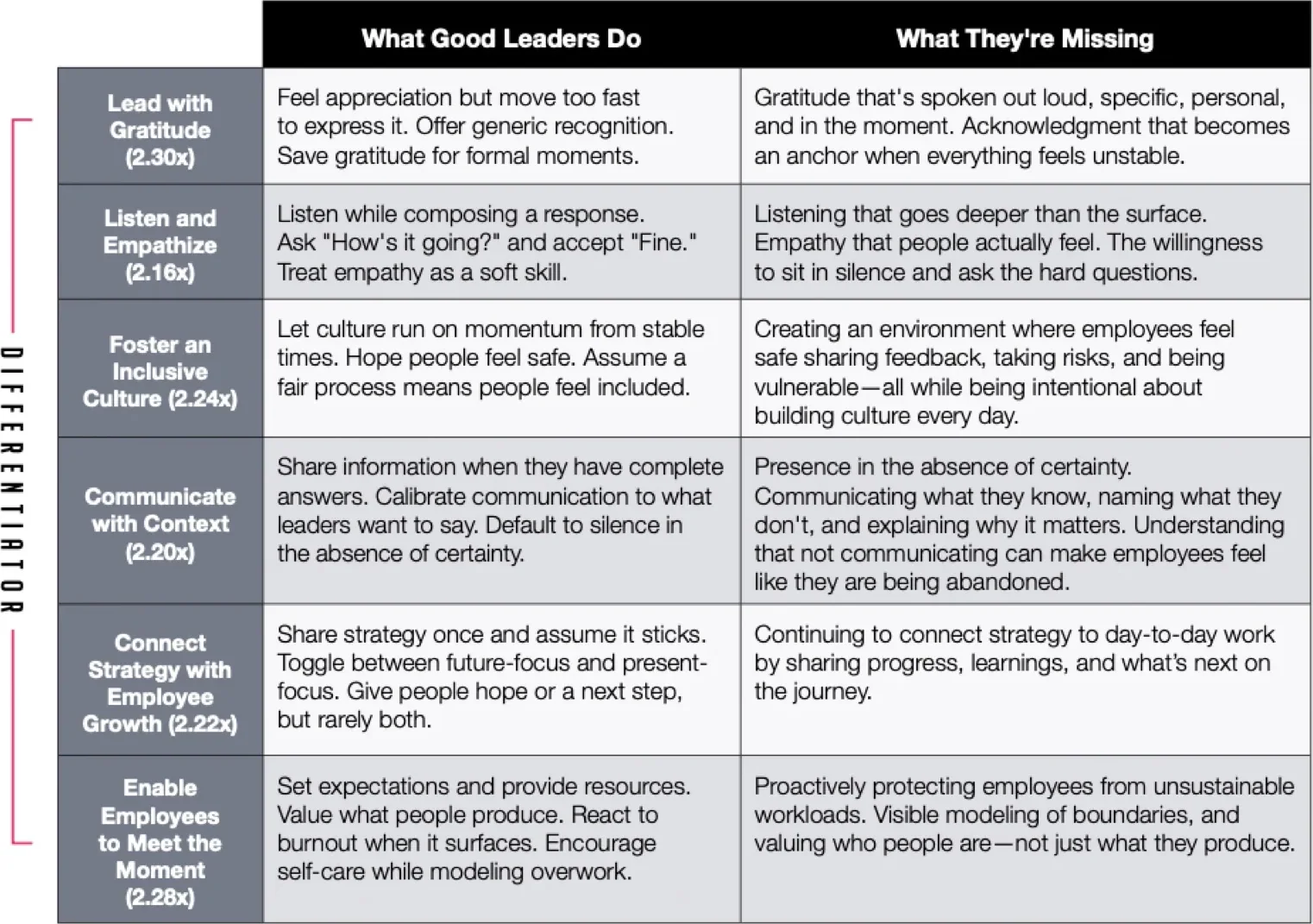
The research identified six specific behaviors where exceptional leaders are more than 2x stronger than good leaders.
Lead with Gratitude (2.30x): Good leaders feel appreciation but rush past it. Exceptional leaders speak gratitude out loud—specific, personal, and immediate.
Listen and Empathize (2.16x): Good leaders listen while composing a response. Exceptional leaders listen to understand, sitting in silence and asking the hard questions.
Foster an Inclusive Culture (2.24x): Good leaders let culture run on momentum. Exceptional leaders intentionally build a safe environment for risk and vulnerability.
Communicate with Context (2.20x): Good leaders wait for complete answers. Exceptional leaders show up in the absence of certainty—naming what they know, what they don’t, and why it matters.
Connect Strategy with Employee Growth (2.22x): Good leaders share strategy once. Exceptional leaders continuously connect the company’s future to the employee’s personal growth.
Enable Employees to Meet the Moment (2.28x): Good leaders provide resources but react to burnout. Exceptional leaders proactively protect workloads and model boundaries.
Closing the Gap: Four Actions You Can Take Today
You don’t need a personality transplant. You need a behavior shift. Here is where to start:
1. Move from recognizing the work to recognizing the person.
Don’t just say, “Great job, team.” Say, “I noticed what you did in that meeting. It mattered.” Name the behavior. Name the impact. Connect the work to what the person actually cares about.
2. Take off the armor.
When you remain unreadable, you don’t project calm—you create fear. In your next team conversation, share one thing you are uncertain about alongside what you do know. Model that leaders don’t need all the answers; they need to be present and honest.
3. Ask the questions that require courage.
Good leaders answer questions. Great leaders ask them: “What are you carrying right now that I should know about?” “What are you afraid to say out loud?” Sit in the silence. Don’t accept “fine.”
4. Show people their future.
During uncertainty, every employee is asking: “Do I still have a future here?” Don’t just communicate the what. Communicate the why and the you. Help them see themselves in the future you are building.
The Bottom Line
The organizations that thrive will recognize a difficult truth: In this environment, good leadership is no longer good enough.
Uncertainty is the constant. Leadership is the variable. And the employee experience is the outcome. The only responsible choice is to close the gap between good and exceptional—not through heroic effort, but through specific, teachable, human behaviors.
Because your people aren’t just looking for information. They are looking for meaning. And that is a gap that only heart-led leadership can close.