New Research Shortens Timelines as Startups Race to Build Off-World Civilizations
For decades, the dream of transforming Mars into a second home for humanity has lived in the realm of science fiction — a multi-millennial project requiring technologies far beyond our current grasp. But recent breakthroughs are challenging that assumption. New research published in Science Advances and presented at major scientific conferences suggests that making Mars warm enough for liquid water — the first critical step toward habitability — could take just 15 years, not centuries .
Meanwhile, a new generation of startups is quietly building the infrastructure that will turn red dust into human habitat, from expandable space stations to lunar hotels that serve as proving grounds for Martian cities.
The Science: Engineered Aerosols and Radical Terraforming
The greatest obstacle to life on Mars is brutal cold. With an average surface temperature of -80°F (-60°C) and an atmosphere 100 times thinner than Earth's, liquid water cannot exist on the surface. Traditional terraforming proposals — like importing greenhouse gases from Earth or detonating nuclear bombs at the poles — have been deemed logistically impossible or dangerously impractical. But a paradigm shift is underway.
Warming Mars in 15 Years
A groundbreaking study published in Science Advances demonstrates that engineered nanoparticles — specifically, rod-shaped aerosols made from iron and aluminum — could be released into the Martian atmosphere to trap heat with extraordinary efficiency . Unlike greenhouse gases that absorb infrared radiation, these metallic particles are designed to backscatter thermal radiation back toward the surface, creating a powerful localized greenhouse effect.
The numbers are striking:

According to simulations using advanced 3D atmospheric models, releasing these particles at a rate of just 3 liters per second for five Martian years, then increasing to 60 liters per second, could raise surface temperatures by approximately 35°C — more than enough to allow liquid water to form and persist.
"This study only addresses some aspects... atmospheric processes are inherently complex, and many open questions remain," the research team led by Mark I. Richardson cautions. However, the implications are profound: for the first time, a scientifically plausible pathway to planetary warming exists that uses resources already available on Mars.
Radical Terraforming: A Bolder Vision
At the European Geosciences Union (EGU) General Assembly 2026, planetary scientist Leszek Czechowski presented an even more ambitious concept: radical terraforming using volatile-rich bodies from the Kuiper Belt.
The proposal envisions redirecting approximately 1,000 asteroids — with a total mass of 10^19 kg — to impact Mars. These impacts would accomplish multiple objectives simultaneously:
Deliver massive quantities of water and volatiles
Generate heat to warm the planet
Create open water reservoirs and rivers
Transform surface minerals through impact metamorphism
"Placing them in appropriate locations can make the economy easier for future residents," Czechowski notes. While the engineering challenges are staggering, the concept demonstrates the creative thinking emerging from the scientific community.
From Warming to Breathing: The Oxygen Challenge
Warming Mars is only the first step. Even after temperatures rise, the atmosphere remains 95% carbon dioxide and completely unbreathable. NASA's MOXIE experiment on the Perseverance rover has already proven that oxygen can be extracted from Martian CO2 — but only at tiny scales .
The long-term vision involves:
Cyanobacteria and engineered plants introduced after warming to begin photosynthesis
A "Great Oxygenation Event" for Mars, analogous to Earth's biological transformation billions of years ago
An artificial magnetic shield at the Mars-Sun L1 Lagrange point to protect the new atmosphere from solar wind erosion
The Startups: Building the Infrastructure for Martian Life
While scientists debate atmospheric chemistry, a new generation of entrepreneurs is building the physical infrastructure that will get humans to Mars — and keep them alive once they arrive.
Max Space: Expandable Habitats
Traditional space habitats are rigid, heavy, and limited in volume by rocket fairings. Max Space is solving this with a radical alternative: expandable structures that launch compact and expand 20x once deployed .

The company has partnered with Voyager Technologies (NYSE: VOYG) to accelerate deep-space human exploration. "This technology reflects a fundamental shift in how humanity will live and work in space," said Dylan Taylor, Voyager's chairman and CEO .
The partnership aims to deliver operational lunar and Mars capabilities aligned with NASA's exploration timelines, with ground validation and in-space demonstrations planned for later this decade.
Vast: Next-Generation Space Stations
Vast has secured $500 million in new funding to accelerate production of its Haven space stations . The company's roadmap includes:

With over 1,000 employees and more than a billion dollars in private capital, Vast has rapidly established itself as a leader in commercial space infrastructure. The company's success in flying, operating, and deorbiting its Haven Demo spacecraft made it the only operational commercial space station company to have flown its own vehicle.
GRU Space: From Lunar Hotels to Martian Cities
Perhaps the most audacious vision comes from GRU Space, a Y Combinator-backed startup (YC W26) founded by UC Berkeley graduate Skyler Chan .
GRU's "Master Plan" is nothing less than the industrialization of the solar system:
Build the first hotel on the Moon (targeting 2032)
Build America's first Moon base — roads, mass drivers, warehouses
Repeat on Mars — build the first cities there
Own property on the Moon and Mars as these economies grow
Reinvest profits into resource utilization across the solar system
"GRU develops in-situ resource utilization technology, transforming local lunar material into durable building structures," the company explains. The first habitat, a lunar hotel, is already accepting reservations with deposits ranging from 250,000 to 1 million.
The technical team includes Dr. Kevin Cannon (former CTO of Ethos Space and Colorado School of Mines professor) and Dr. Robert Lillis (Principal Investigator of NASA's ESCAPADE Mars mission) .
Enabling Technologies: ISRU and Life Support
All these ambitions rest on a critical capability: In-Situ Resource Utilization (ISRU) — using local materials to produce what humans need to survive.
Producing Fuel and Oxygen from Martian Air
Precision Combustion, Inc. has developed a novel CO2 separation and methanation reactor that could extract oxygen and produce methane fuel from the Martian atmosphere . The technology achieves:
≥90% CO2 conversion
Near 100% methane selectivity
Low operating temperatures (≤350°C)
Lightweight, compact design
This integrated system "can contribute significantly to NASA's Martian in-situ resource utilization architecture, offering a potential major step forward towards establishing a human outpost on Mars" .
Electrolyzer Technology for Space Missions
Researchers at the University of Texas at San Antonio and Southwest Research Institute have been awarded $500,000 through NASA's TechLeap Prize to flight-test an electrolyzer that converts simulated Martian brine and CO2 into methane, hydrocarbons, and oxygen .
"This technology allows us to live off the land, converting what is naturally available on other planets into essential resources that support human life and mission success," said project lead Shrihari Sankarasubramanian .
The team is preparing for parabolic flight testing in 2026 to understand how reduced gravity affects the electrochemical processes — critical data for eventual Mars deployment.
The Ethical and Legal Frontier
Not everyone is celebrating the rush to terraform. A comprehensive analysis published in the upcoming book Mars and the Earthlings: A Realistic View on Mars Exploration and Settlement (Springer, 2025) raises profound questions .

The authors note that after 30 years of Mars exploration, the feasibility of traditional CO2-based terraforming is "strongly questioned." Even if technically possible, they argue that terraforming "would violate many principles of modern environmental ethics" and raise complex legal and societal issues regarding governance of extraterrestrial communities .
These concerns are not merely academic. If warming the planet in 15 years becomes possible, humanity will face unprecedented decisions about whether — and how — to transform an entire world.
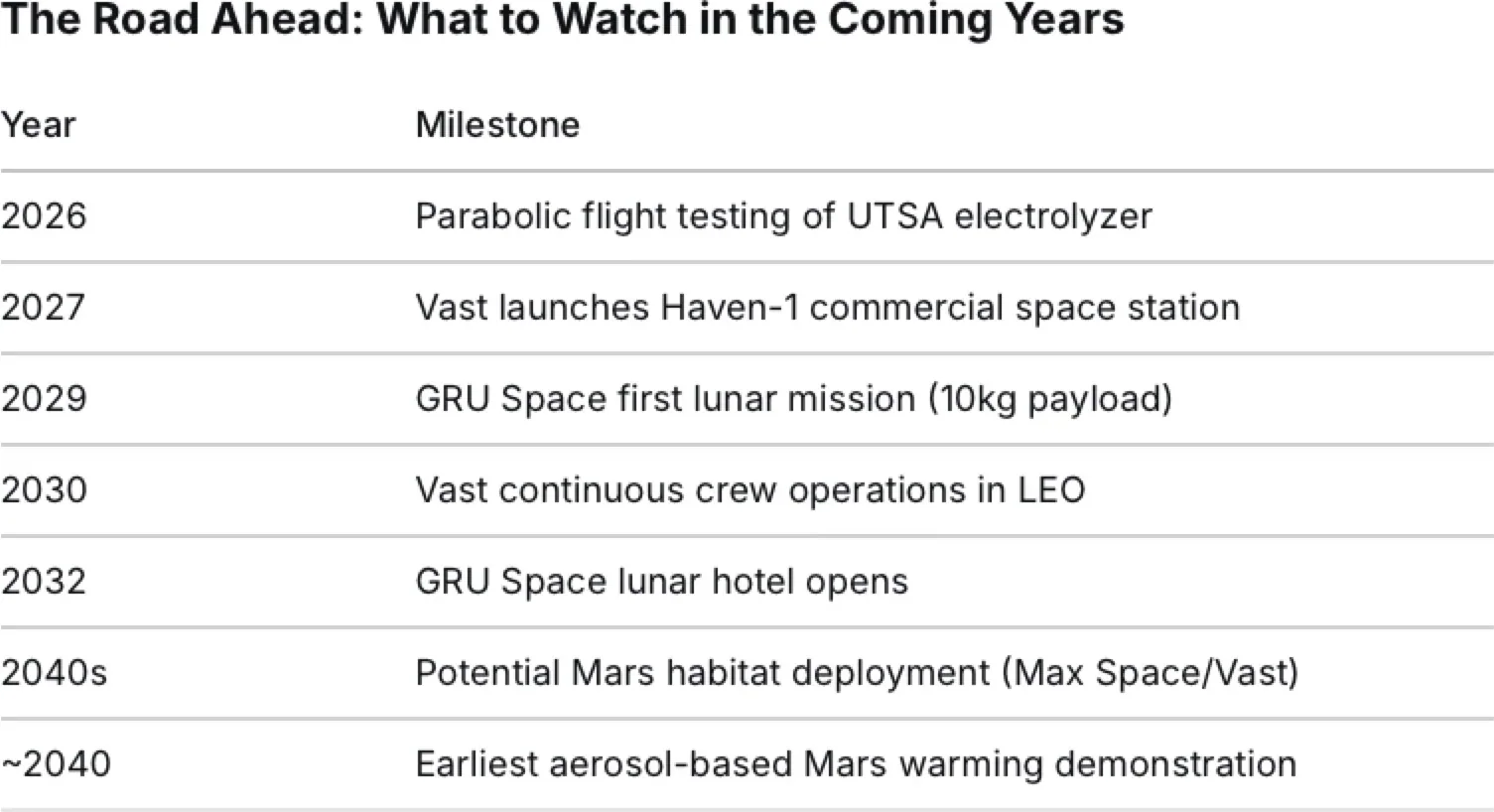
From Dream to Timeline
The convergence of scientific breakthroughs and entrepreneurial ambition is transforming Mars colonization from a distant fantasy into a plausible timeline. New research suggests that the first and most formidable barrier — the killing cold — could be overcome within a single generation using nanoparticles manufactured from Martian soil itself .

Meanwhile, startups are not waiting for the atmosphere to warm. Expandable habitats, in-situ resource utilization, and commercial space stations are being built today, creating the technological foundation for permanent human presence beyond Earth .
The path from Earth to Mars remains long, arduous, and uncertain. But for the first time in human history, there is a credible path — and a growing community of scientists, engineers, and entrepreneurs determined to walk it.
"The next trillion-dollar company will be in human infrastructure: building the first cities on the Moon, Mars, and beyond," GRU Space declares in its manifesto. Whether that vision becomes reality depends on the science, the startups, and the will to face the ethical questions that come with becoming a multiplanetary species.
