A Comprehensive Guide
Introduction: The Evolving Landscape of SEO Investment
Search engine optimization (SEO) has evolved from a niche marketing tactic into one of the most important long-term growth channels for businesses operating online. Industry research suggests that organic search can account for more than 50% of total website traffic for many businesses, making SEO one of the most influential digital marketing channels today.
As we move through 2026, understanding SEO pricing has become increasingly complex. The cost of SEO services varies widely depending on how businesses implement their strategies—whether through agencies, internal teams, freelancers, or specialized software tools. This comprehensive guide explores the current state of SEO pricing, helping businesses make informed decisions about their digital marketing investments.
Average SEO Costs in 2026
Agency Pricing Structures
For companies seeking fully managed SEO campaigns, hiring an agency remains one of the most common approaches. SEO agencies typically manage keyword research and strategy, technical website audits, content optimization and creation, backlink acquisition, and ongoing reporting and analytics.
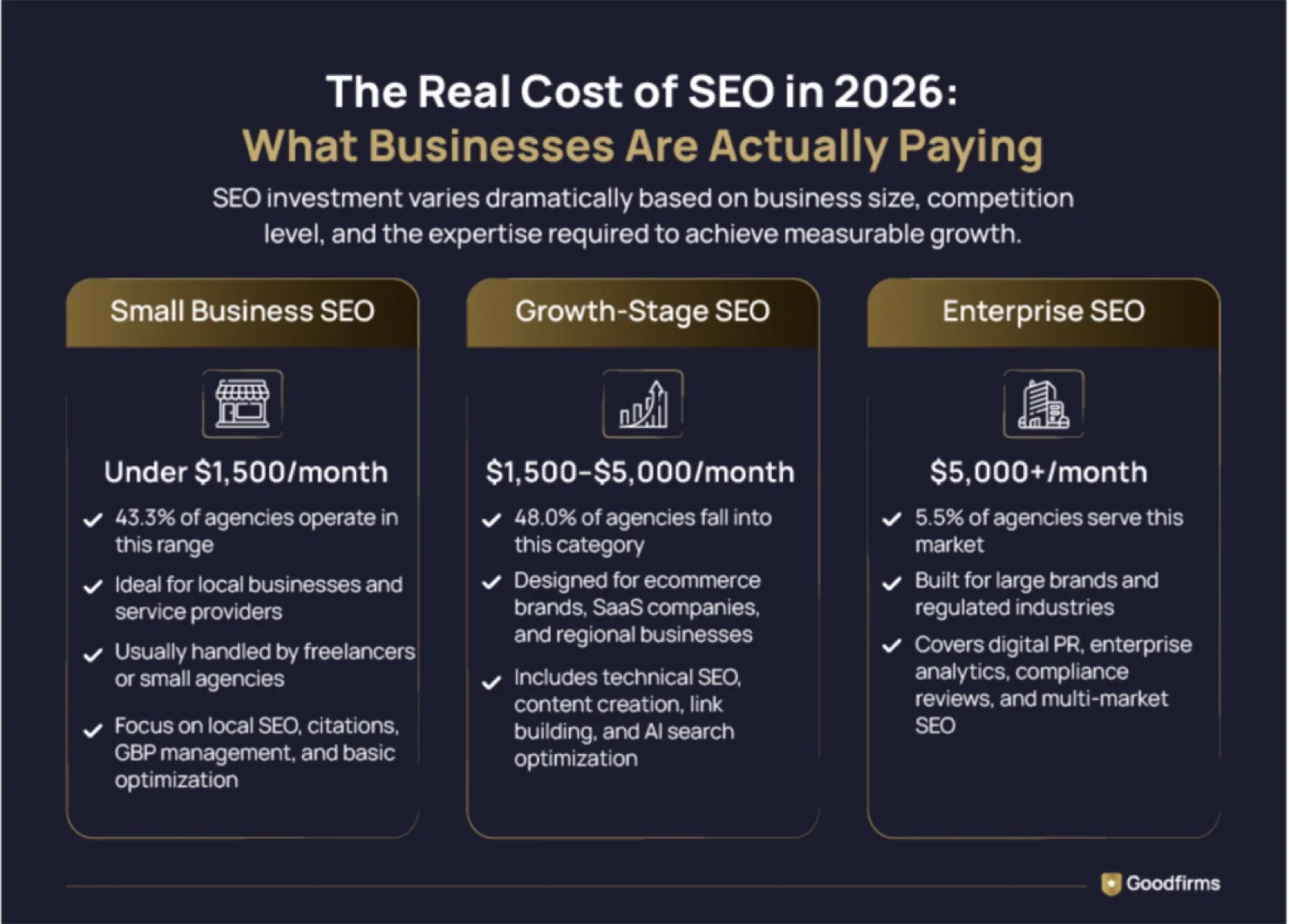
Industries such as finance, SaaS, healthcare, and legal services often require significantly higher SEO budgets because search competition is much stronger.
Freelance SEO Specialist Costs
Startups and smaller businesses often work with freelance SEO consultants instead of agencies. Freelancers may specialize in specific areas such as keyword research, on-page optimization, technical SEO audits, link building outreach, or SEO strategy consulting.
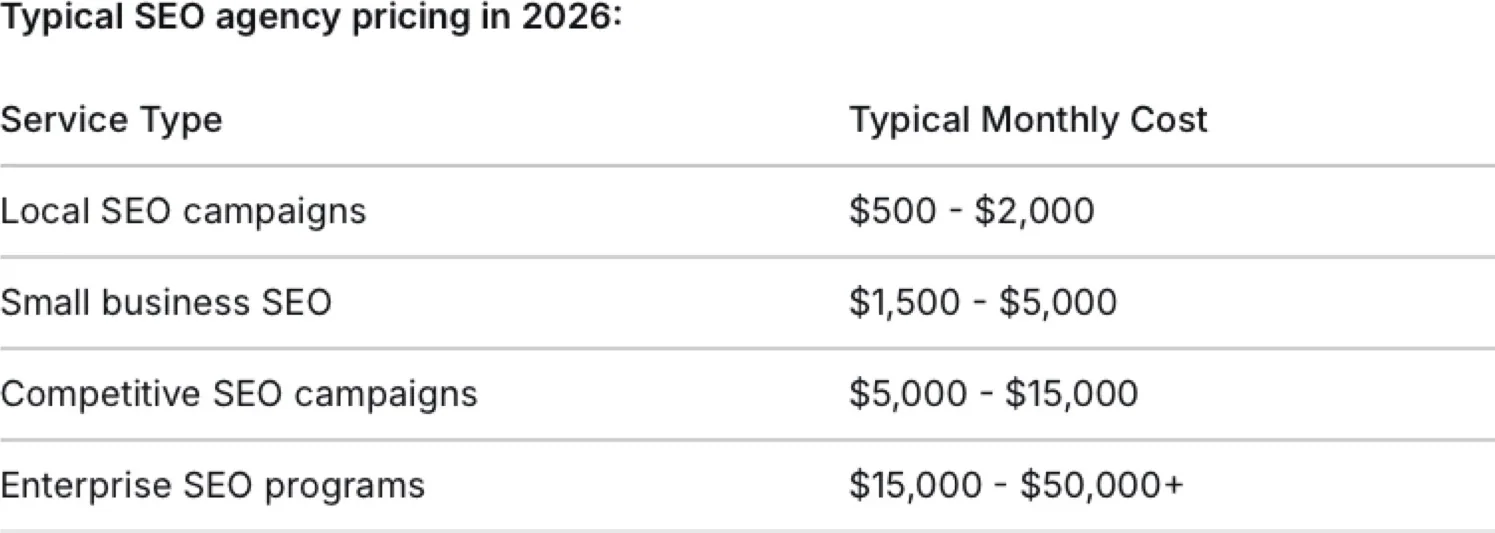
Freelancers can provide cost-effective expertise, but larger SEO campaigns often require multiple specialists and broader strategic coordination.
In-House SEO Team Costs
Companies that depend heavily on organic traffic frequently build internal SEO teams. These teams may include SEO managers, technical SEO specialists, content strategists, link building specialists, and SEO analysts.
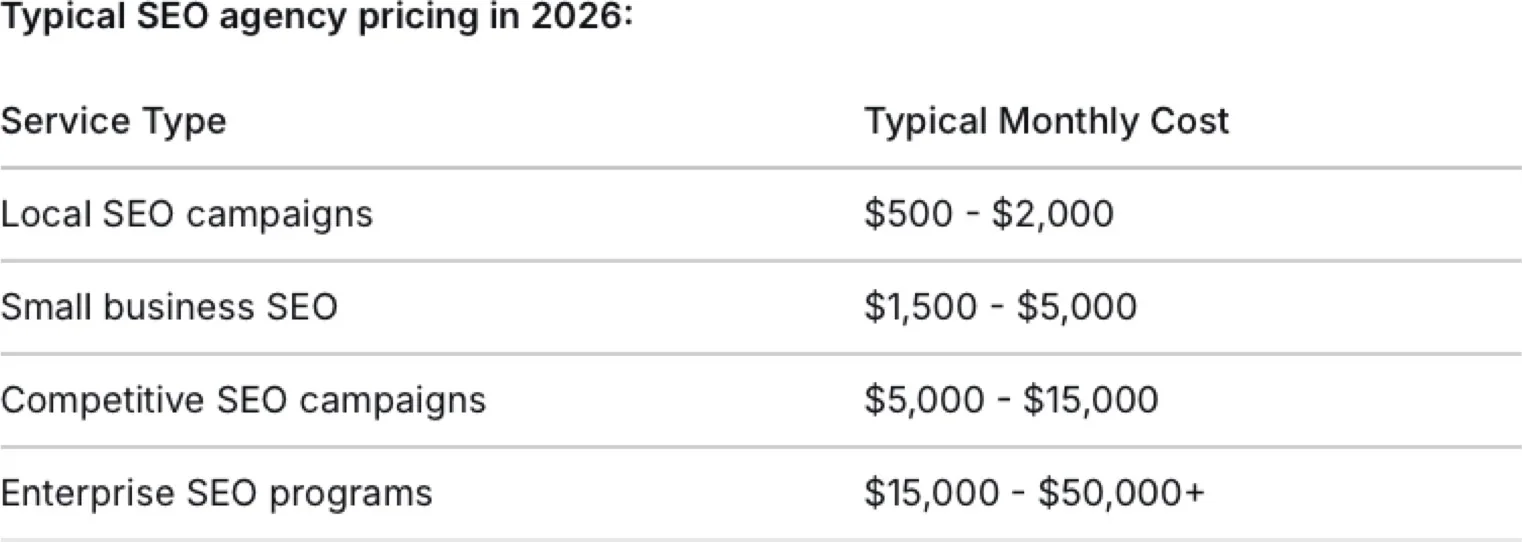
When salaries, benefits, and operational expenses are included, building a complete in-house SEO team can cost companies $250,000 to $500,000+ annually .
Understanding the Factors That Influence SEO Pricing
Website Complexity
The size and health of your website is one of the biggest cost drivers. A ten-page service website in a low-competition niche needs far less work than a 500-page e-commerce site with years of accumulated technical issues. Key considerations include:
Number of pages and site structure
Volume and severity of existing technical SEO issues
Whether the site is an e-commerce platform with product catalogues to optimize
Number of locations and whether individual pages or Google Business Profiles are needed for each
Market Competition
A business serving a small local market faces a very different competitive landscape to one targeting national or international searches. Market factors that influence pricing include:
How competitive the industry is on Google
Whether targeting local, regional, or national searches
The difficulty of the keywords being targeted
The volume and quality of content needed to succeed
Level of Ongoing Activity
SEO isn't a one-time task. It's an ongoing programme of technical improvements, content creation, link building, and performance monitoring. The more competitive your market, the more sustained activity you need to stay ahead. A higher monthly investment typically reflects a higher volume of deliverables each month.
Agency Capability and Model
Not all agencies are the same. A freelancer working alone will charge differently to a full-service agency with in-house technical specialists, content writers, and digital PR teams. The pricing difference reflects the depth of expertise and the range of tools being applied to your campaign.
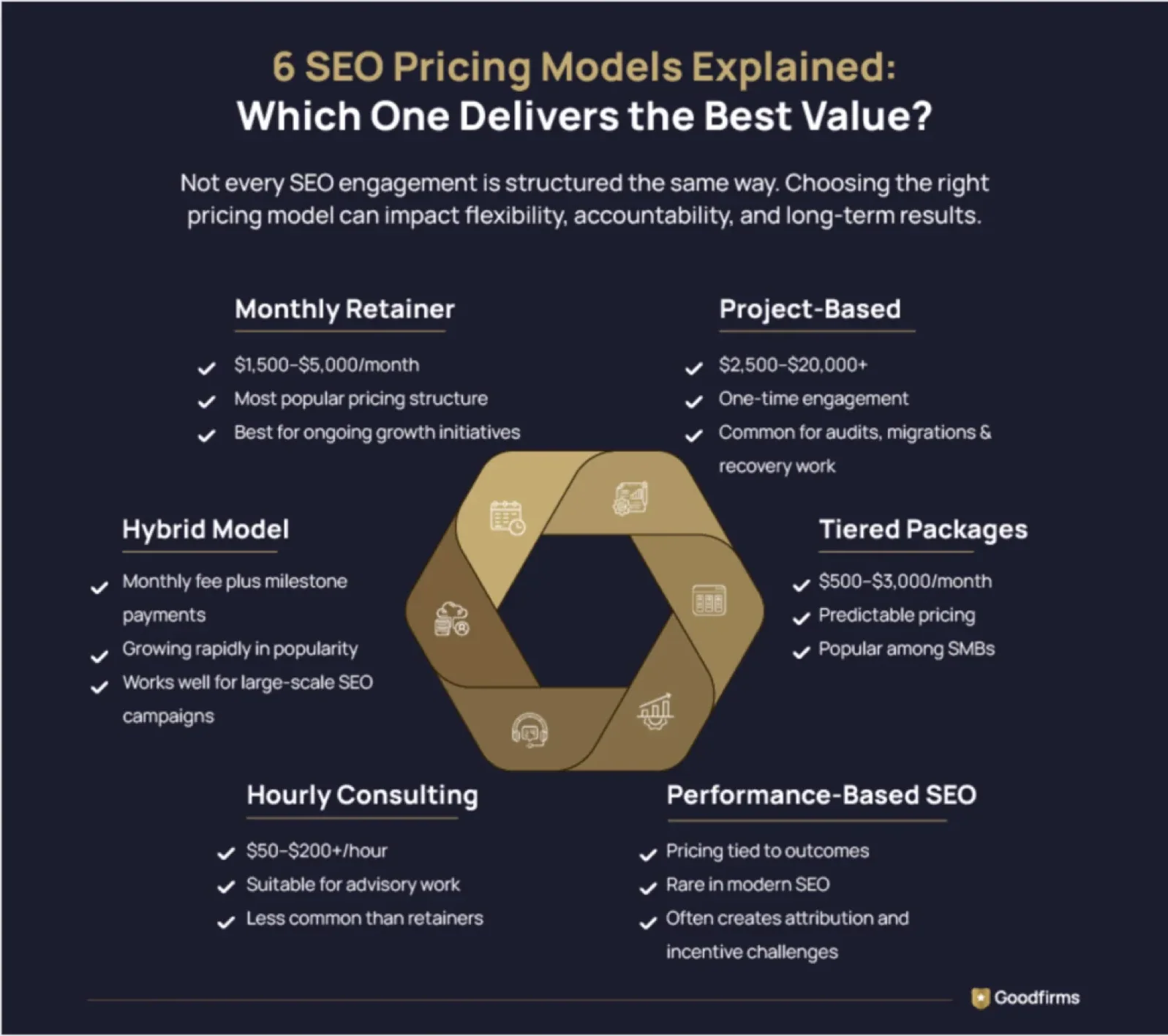
SEO Pricing Models in 2026
Monthly Retainer Model
The most common and cost-effective approach for sustained SEO campaigns. You pay a fixed monthly fee in exchange for an agreed scope of work—a set of deliverables, ongoing activity, and regular reporting. This model offers predictability and continuity.
Hourly Pricing
Some experts charge by the hour, typically between $75 and $200 per hour for an experienced practitioner. This can work for ad hoc tasks, but it creates a potential conflict of interest—slow work earns more money. It also makes budgeting difficult. Genuine, outcome-focused agencies rarely lead with hourly pricing.
Project-Based Pricing
One-off projects—such as a technical audit, site migration, or content sprint—are sometimes priced as a fixed fee. This works well for defined, time-limited scopes, but it's rarely sufficient on its own for businesses that need sustained organic growth.
Performance-Based Pricing
Some agencies offer to tie their fee to rankings or traffic. While this sounds appealing, caution is advised. Performance-based contracts often incentivize short-term gains over sustainable strategy, and they can be structured in ways that don't reflect actual business value—ranking for easy keywords rather than ones that convert.
The Current State of the SEO Agency Market
Revenue and Pricing Trends
A survey of 73 SEO agencies in 2026 revealed significant insights into the industry's current state:
70% of SEO agencies make under $50,000 in monthly recurring revenue
42.5% charge less than $1,000 per month for SEO services
Another 26% charge between $1,000 and $2,500
Only 12.3% command retainers between $5,000 and $10,000
Just 8.2% charge above $10,000 monthly
Profitability Challenges
Most agencies operate on thin margins:
41.1% report gross margins under 30%
39.7% fall in the 30% to 50% range
Only 13.7% achieve margins between 50% and 70%
Just 5.5% exceed 70%
These low margins make it challenging for agencies to invest in growth, hire new talent, or improve client retention.
Pricing Barriers
According to agency surveys, the biggest pricing barriers include:
Competition (48%)
Client ROI doubts (37%)
Internal confidence issues (8.2%)
Growth Constraints
The main challenges agencies face in growing their business:
Not enough qualified leads (39.7%)
AI impact reducing perceived SEO value (24.7%)
Client churn (17.8%)
Weak differentiation in the market (16.4%)
Delivery capacity and hiring challenges (13.7%)
What Different Budgets Actually Deliver
Foundational Tier (£750 - £1,500/month)
3-6 hours of senior specialist time per week
1-2 articles per month
1-3 link placements per month
Basic technical audit and light implementation
Monthly reporting
Growth Tier (£1,500 - £3,500/month)
6-10 hours of senior time per week
2-4 articles per month
3-6 link placements per month
Audit + light technical implementation
Monthly reporting with quarterly executive reviews
Advanced Tier (£3,000 - £5,000/month)
12-20 hours of senior time per week
4-8 articles per month
6-12 link placements per month
Full technical implementation
Bi-weekly reporting
Enterprise Tier (£6,000 - £15,000+/month)
25-40+ hours of senior team time per week
8-20+ articles per month
15-30+ link placements per month
Multi-market, multi-language, complex schema and migration capacity
Weekly reporting with executive dashboards
SEO Software and Tools Costs
Even companies with internal SEO teams rely heavily on specialized research and analytics software. Typical pricing for professional SEO software ranges from $100 to $500 per month, depending on the data depth and number of users.
For example, SE Ranking offers:
Essential plan: $23.40 per month
PRO plan: $53.40 per month
Features include keyword rank tracking, website audits, backlink monitoring, competitive research, and on-page optimization tools.
Agency vs. Freelancer vs. In-House: Making the Right Choice
Freelancers
Pros: Cost-effective for smaller businesses with straightforward needs, genuine expertise, flexibility, competitive pricing
Cons: Capacity and breadth limitations, single point of failure, limited specialisms
In-House Teams
Pros: Deep brand knowledge, full availability, tight integration with marketing
Cons: High overhead, harder to scale, single person can't cover every specialisation
Agencies
Pros: Access to a full team of specialists, cross-sector experience, cost-effective compared to building in-house
Cons: Quality varies significantly, less direct control
Comparison of provider types:
Freelancer: £50-£500/month (basic), limited specialist coverage
Small agency: £500-£1,500/month, some specialist coverage
Full-service agency: £1,300+/month, full specialist team, transparent reporting
Red Flags to Watch For
"Number of keywords" pricing - Rankings on irrelevant keywords don't drive revenue
£300-£500 monthly retainer with promised "rankings" - The maths doesn't work for legitimate tactics
12-month minimum lock-in with no break clause - Confidence in the work means the agency keeps earning your spend
Anonymous account managers - If you can't see who is doing the work, you're buying a black box
No reporting structure agreed before signing - Define metrics, cadence, and review format in the contract
AI-only content at premium pricing - AI-assisted content production is fine, but AI-only content priced like senior editorial is not
Industry Outlook for 2026
Key Trends
Agency growth: 56.2% of agencies are successfully raising retainer prices in 2026
Efficiency focus: 60.3% are building automations to reduce delivery costs
AI adaptation: 63% of agencies have already changed their SEO KPIs because of AI Overviews
Investment priorities: Building better SEO and AEO tool stacks (53.4%), building personal brands (42.5%), and training teams on AI search (31.5%)
Agency Concerns for 2026
The biggest concerns facing the SEO industry:
SEO impact on revenue becoming harder to measure (45.2%)
Google Ads and AI Overviews eating organic traffic (43.8%)
Difficulty executing SEO without investments in brand marketing (42.5%)
Commoditization of SEO services (20.6%)
Conclusion: Making Informed SEO Investment Decisions
SEO pricing in 2026 reflects a complex landscape where businesses have multiple options—from freelancers and agencies to in-house teams and software tools. Most businesses pay between $500 and $5,000 per month for professional SEO services, with costs varying based on business size, industry competition, geographic targets, and website complexity.
The key to making the right investment is understanding what you're actually paying for and ensuring it aligns with your business goals. As one industry expert notes, "Most ambitious brands sit at £1,500-£5,000/month for SEO work that materially moves rankings and revenue".
When evaluating SEO options, look beyond the price tag to understand the seniority of the people doing the work, what's included in the scope, and how results will be measured. The cheapest option is rarely the best value, and the most expensive isn't always necessary—the right investment depends on your specific market position, competition, and growth objectives.
SEO remains a long-term investment that typically takes 3 to 6 months to see meaningful results . With the right partner and realistic expectations, it can deliver substantial returns through increased visibility, traffic, and ultimately, revenue.